
Understand what AI Employee is, how its Voice AI and Conversation AI capabilities work, what the current pricing structure means, its limitations, and whether it fits your business or agency.
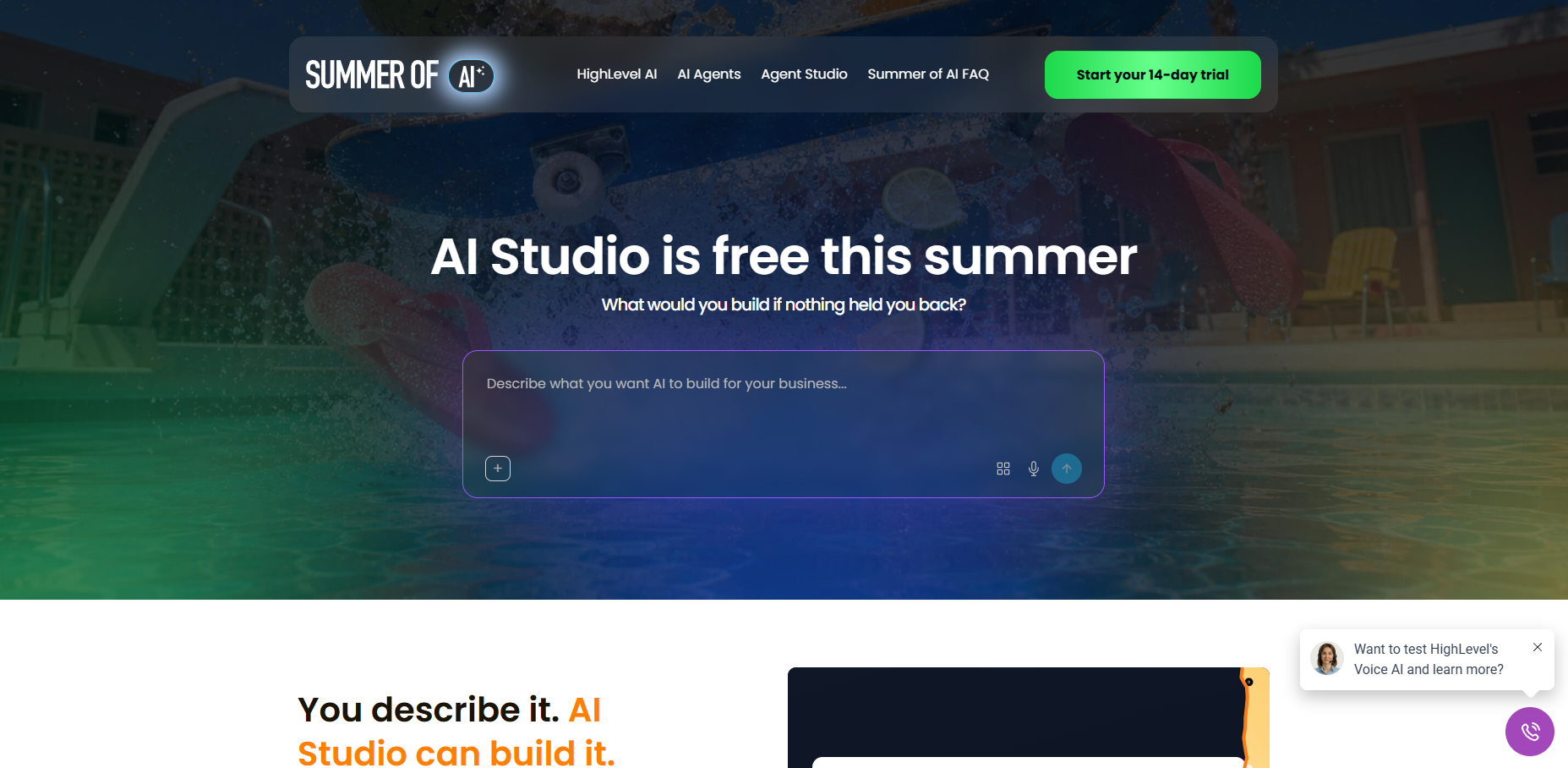
AI Employee is HighLevel’s umbrella offering for multiple AI products. HighLevel’s current documentation includes Conversation AI, Voice AI, Reviews AI, Content AI, Ask AI and AI Studio, with product-specific billing rules that buyers should verify before purchase.
AI phone agents for answering, qualifying, booking and follow-up workflows.
Automated lead conversations across supported messaging channels.
Assistance with review responses and marketing content production.
In-product assistance for questions and supported tasks.
Prompt-driven creation of websites and other digital experiences.
Advanced agent building; currently priced separately on a pay-per-use basis.
These guides cover the distinct decisions buyers make before activating HighLevel AI Employee.
Review the suite, strongest use cases, limitations and who should be cautious.
Understand Growth, Unlimited, Pay-Per-Use and costs that can remain outside the subscription.
See how Voice AI, Conversation AI, knowledge, calendars, workflows and handoffs fit together.
Compare an integrated HighLevel AI stack with specialist and human-assisted options.
AI tools are moving from isolated writing assistants into systems that can participate in day-to-day customer communication. HighLevel calls its collection of these tools AI Employee. The important distinction is that this is not one humanoid “employee” or a single chatbot. It is a group of AI capabilities inside the broader HighLevel platform, including tools for conversations, voice calls, review responses, content, in-app assistance and AI-assisted building.
That framing matters when you are deciding whether it fits your business. A local service company may care most about answering missed calls and booking appointments. An agency may care about deploying AI capabilities across client sub-accounts and, where its plan supports it, rebilling or reselling those services. A sales team may care more about rapid lead response across messaging channels. The value therefore depends less on the phrase “AI employee” and more on whether the specific workflows you need are supported, economical and safe to automate.
This guide is built for buyers who want to understand that decision before starting a trial. We focus on the questions that change a purchase decision: what the current AI suite includes, where usage charges can still appear, which businesses have a strong use case, what needs human oversight, and when a narrower specialist tool may make more sense.
HighLevel’s current AI offering spans Conversation AI, Voice AI, Reviews AI, Content AI, Ask AI and AI Studio, while other AI capabilities such as Agent Studio have their own usage economics. That breadth can be attractive if you already want a CRM and marketing automation environment rather than another standalone AI application. It also means buyers should evaluate the whole platform relationship, not only a single headline feature.
The clearest use case is a business where customer communication is repetitive, time-sensitive and connected to a measurable next action. Think inbound questions that should lead to a booked appointment, a missed call that needs an immediate response, common qualification questions, or review responses that consume staff time. In those situations, automation can be useful because the work has a repeatable structure and can be monitored.
The weakest use cases are tasks where judgment, negotiation, emotional sensitivity or unusual edge cases dominate. An AI system can support those processes, but “automate everything” is usually the wrong implementation goal. A practical rollout starts with a narrow job, a clear escalation path and a way to inspect outcomes before expanding.
Voice AI is one of the more concrete parts of the suite. HighLevel documents voice agents that can answer calls, qualify leads, schedule appointments, provide information and trigger follow-up actions. Businesses considering this should also account for telephony requirements and charges. HighLevel notes that Voice AI works with LC Phone or Twilio numbers, and phone-system charges can apply separately from AI plan pricing.
Conversation AI is aimed at text-based lead handling and can participate across customer messaging channels. The business case is straightforward: faster responses can reduce the number of leads that go cold while staff are busy. But response speed alone is not enough. The bot needs accurate business information, sensible instructions and a handoff rule for questions it should not answer.
Reviews AI and Content AI address a different workload. They can reduce repetitive drafting work, but these features should not be confused with a complete reputation or content strategy. A generated review reply still represents your business publicly, and generated marketing content still needs factual review, brand judgment and compliance checks where applicable.
Ask AI and AI Studio broaden the proposition beyond customer-facing agents. Ask AI is positioned as an assistant inside HighLevel, while AI Studio can build web experiences and other assets from prompts. These capabilities may increase the value of keeping work in one platform, particularly for teams already using HighLevel for CRM, funnels and automation.
Pricing deserves careful attention because “AI Employee” does not mean every AI action is universally unlimited. HighLevel currently documents pay-per-use, AI Employee Growth and AI Employee Unlimited options. The Growth plan is listed at $50 per month per enabled location and the Unlimited plan at $97 per month per enabled location, while pay-per-use has no AI monthly subscription fee and bills supported usage. Some products have separate rules; Agent Studio, for example, remains pay-per-use across the AI Employee plan options.
For that reason, the right question is not simply “What does AI Employee cost?” It is “What will my actual workflow use, and which charges remain outside the subscription?” Phone-system charges are an important example. Model, text-to-speech or token costs can also matter depending on the product and plan. Always verify current in-app pricing before committing because AI pricing and model availability can change quickly.
Agencies have an additional dimension: client access and monetization. HighLevel documents controls for enabling AI Employee by sub-account, plus rebilling and reselling paths under qualifying agency configurations. That can make the platform commercially interesting to agencies that want to package AI-enabled services. It also increases the need for clear client expectations, usage monitoring and transparent pricing.
A sensible evaluation begins with one revenue-adjacent workflow. Choose something like inbound call answering, lead qualification or appointment booking. Write down what a successful interaction looks like, what information the agent needs, which actions it is allowed to take, and when a human must take over. Then test against real-world edge cases before making the AI the default path.
You should also measure the boring operational outcomes rather than relying on novelty. Useful metrics include response coverage, qualified conversations, booked appointments, escalation rate, correction rate and staff time saved. Avoid assuming that more AI activity is automatically better. A system that produces fewer but more accurate and useful interactions can be more valuable than one that maximizes volume.
Security and compliance deserve their own review. HighLevel publishes information about privacy and infrastructure controls, but your obligations depend on your industry, location, data, consent practices and the exact workflows you configure. Businesses in regulated or sensitive environments should not treat a platform marketing page as legal advice.
The final buying decision comes down to fit. AI Employee is most compelling when you want several AI functions connected to the same CRM and automation environment. It may be less compelling if you need only one specialized AI capability, already have a mature CRM stack you do not want to replace, or require unusually deep customization outside HighLevel’s model.
Our recommendation is to evaluate the current trial offer around a defined workflow rather than “trying AI.” Build one agent or automation, test it, review the resulting conversations and costs, and decide whether the platform reduces a real operational bottleneck. That gives you evidence you can use, rather than a feature checklist that looks impressive but never becomes part of the business.
Use a real customer journey rather than a demo script. Confirm what happens when the AI does not know an answer, when the requested appointment time is unavailable, when a caller wants a person, when contact information is incomplete and when the customer changes direction halfway through the conversation. Review the resulting contact record and any workflow actions as well as the words the AI produced.
Record the operating cost alongside the outcome. A successful test should tell you not only whether the agent can respond, but whether it can create a useful business result with acceptable supervision. Keep notes on corrections, escalations, bookings and staff intervention so the decision is based on evidence rather than novelty.
Use the trial to test one real workflow and verify current pricing, limits and terms in your account.
View HighLevel AI offerIf AI Employee is on your shortlist, the most useful next step is to inspect the current offer and confirm the plan, included usage and terms for your account.
Disclosure: We may earn a commission if you sign up through this link, at no additional cost to you.
View the current HighLevel AI offer